Monday, September 22, 2025

PH25006 Gravitational Waves - Obituary Rainer Weiss V01 220925


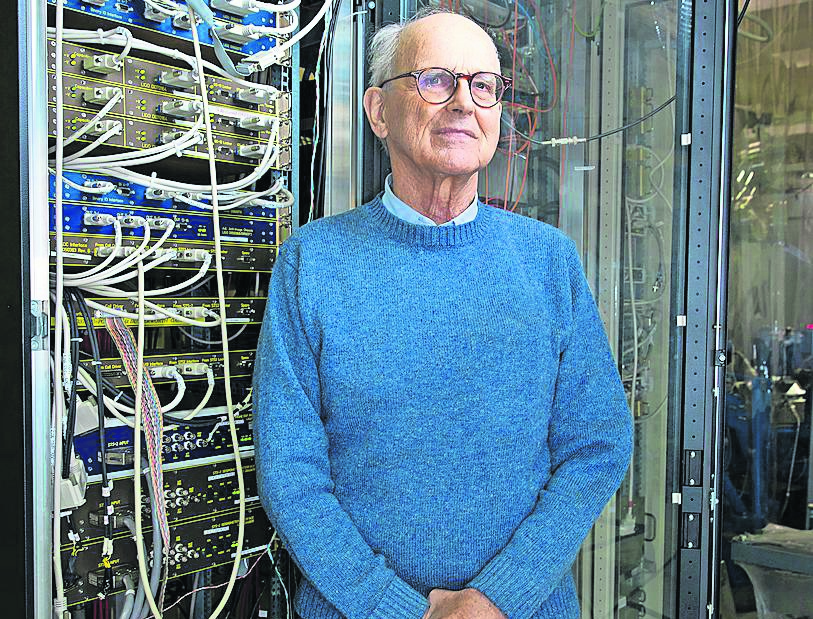
Rainer  originally went to MIT to study electrical engineering but moved to physics

Early in the American morning on September 14, 2015, researchers made a discovery that would advance the field of astrophysics and promise to deepen our understanding of the universe.

On holiday in Maine, Rainer Weiss logged on to his computer, saw the news and yelled “My God!” The observatory he helped to build had registered the “chirp” that he had longed for: a faint signal converted into an audible sound representing a cataclysmic crash that rippled through the cosmos. It earned him the Nobel prize in physics.

The Laser Interferometer Gravitational-Wave Observatory (Ligo), with its vast installations nearly two thousand miles apart, had spotted gravitational waves from the last fraction of a second of a ferocious clash of two merging black holes some 1.3 billion years ago. Predicted a hundred years before by Albert Einstein in his general theory of relativity, the waves are ripples in space-time, the four-dimensional “fabric of the universe”, caused by violent events such as supernovas and collisions of neutron stars. Detecting them gives astrophysicists new tools for observing the universe.

Funded by the United States government at a cost of more than $1.1 billion (about £800 million today) and jointly operated by the Massachusetts Institute of Technology (MIT) and the California Institute of Technology (Caltech), Ligo began operating in 2002 after eight years of construction with the goal of perceiving processes that, despite their force, are extraordinarily tiny once their effects arrive on Earth.

“By the time gravitational waves from Ligo’s first detection reached us, the amount of space-time wobbling they generated was 10,000 times smaller than the nucleus of an atom,” the observatory noted.

Einstein came to doubt whether gravitational waves would ever be measured. “It would have been wonderful to watch Einstein’s face had we been able to tell him,” Weiss remarked after the finding was publicly announced in February 2016.

The observation was not only a validation of Einstein’s theory but of the work of Weiss, a German-born American MIT physics professor who was a central figure in the conception and development of Ligo, having designed a laser antenna to detect gravitational waves and built a prototype in 1972.

Feats of design and engineering, the interferometers in Louisiana and Washington state consist of two 2.5 mile-long antennae fitted with laser beams that travel along chambers that extend like arms in an “L” shape. The beams of light reflect off mirrors at the end of the tubes and recombine to generate patterns, allowing scientists to track minuscule changes in length caused by the squeezing and stretching of space-time as gravitational waves reach our planet. Ligo is, according to its operators, akin to the most precise ruler in the world, capable of measuring on scales ten thousand trillion times smaller than a human hair.

Securing significant public funding for such an esoteric venture was predictably tricky. “Everybody thought we were out of our minds,” Weiss recalled.

The sensitive and delicate equipment required extensive upgrades to improve performance and proved vulnerable to external damage. Weiss walked along the chambers and found cracks and other flaws caused by rodents, wasps and black widow spiders.

Ligo evolved into a project involving a thousand people. The 2017 Nobel was awarded to three, for their “decisive contributions” to the observatory and to gravitational wave detection: Weiss received a half share, with the rest allotted to the Caltech physicists Barry Barish and Kip Thorne.

‘It would have been wonderful to watch Einstein’s face,’ he said 

Weiss, Thorne — an affable, Utahborn friend of Stephen Hawking who was the science adviser for the Christopher Nolan film Interstellar — and Ronald Drever, a Scottish scientist described by Weiss as a “scientific Mozart”, were dubbed the original “troika” for their early efforts. Barish, a gifted manager born in Omaha, joined Ligo in the mid-Nineties and guided it to fruition after some turbulence.

Personality clashes were easy to detect. Weiss, a collaborative and pragmatic New Yorker, supported recruiting Drever from the University of Glasgow.

While brilliant, Drever’s propensity for independent thought did not always delight his colleagues. An entrance to his office was bricked up to make it harder for him to bother the group’s secretary and he was forced off the project in 1992 after falling out with Rochus Vogt, the head of Ligo. Drever (obituary, March 18, 2017) later suffered from dementia and died seven months before the Nobel was announced, making him ineligible for the prize.

Rainer “Rai” Weiss was born in Berlin in 1932. His father, Frederick, was a neurologist and a Jewish communist who was abducted by a “Nazi gang”, Weiss said, after speaking out against Nazis at his hospital. He was released after lobbying by Rainer’s mother, Gertrude Loesner, an actress and a Protestant.

The family then moved to Prague.

On holiday in a hotel in the Tatras in 1938, they adjusted the dials on an old wooden radio to hear Neville Chamberlain’s voice clearly after the Munich Agreement was signed. Realising the ominous implications for Czechoslovakia, the family emigrated to the US in January 1939.

They settled in New York City, where Rainer pursued his passions for music and tinkering with gadgets, combining the two by acquiring cheap military surplus electronic equipment and making and modifying amplifiers, loudspeakers, ham radio transmitters and FM radio receivers.

His father, who became a psychoanalyst and saw patients in the family’s apartment, rebuked him for playing music too loudly. But the teenager was soon invited to build hi-fi sets for his father’s friends. A piano player and a fan of classical music, Weiss grew irked by distortion from scratchy 78 rpm records, a hiss that he found especially bothersome during slow movements while listening to Beethoven. “I started life with one ambition. I wanted to make music easier to hear,” he told the scientist and author Janna Levin.

Aiming to acquire specialist knowledge for his goal of improving sound quality, Weiss enrolled at MIT to study electrical engineering but switched to physics. However, distracted by lovesickness from a failed long-distance relationship with a student in Illinois, he “flunked out” in 1953. He found a way to stay at MIT, securing a role as a technician at the Atomic Beam Laboratory, where a professor, Jerrold Zacharias, took him under his wing. Weiss’s handson electrical skills were valuable as they worked on atomic clocks.

Weiss was allowed to resume his degree then completed a PhD in 1962.

He enjoyed a formative spell at Princeton under the prominent physicist Robert Dicke before returning to MIT as a faculty member, where he started a laboratory focused on cosmology and gravitation. Before long he applied his experimental talents and boyhood interest in instrumentation and background noise reduction to the challenge of gravitational wave detection.

In 1959 he married Rebecca Young, a plant physiologist at Harvard who became a librarian. She survives him with their children, Sarah, an ethnomusicologist, and Benjamin, an art historian and museum curator, and a sister, Sybille, who became a playwright.

Weiss also had a hand in another Nobel-winning endeavour. He chaired the science working group for the Nasa Cosmic Background Explorer project.

The satellite operated from 1989 to 1993 on a mission to map and measure cosmic background radiation. Its findings provided evidence to support the bigbang theory and secured the Nobel prize for physics for two of its scientists.

His turn would come a little over a decade later. The Nobel was one of many prizes awarded to Weiss to mark the fulfilment of a near 50-year quest.

“It’s a spectacular signal,” he told MIT News after the initial detection. “This is the first real evidence that we’ve seen now of high-gravitational field strengths: monstrous things like stars, moving at the velocity of light, smashing into each other and making the geometry of space-time turn into some sort of washing machine.”

Rainer Weiss, Nobel prizewinning physicist, was born on September 29, 1932. He died on August 25, 2025, aged 92

Saturday, September 20, 2025

PH25005 Measuring Time V01 200825

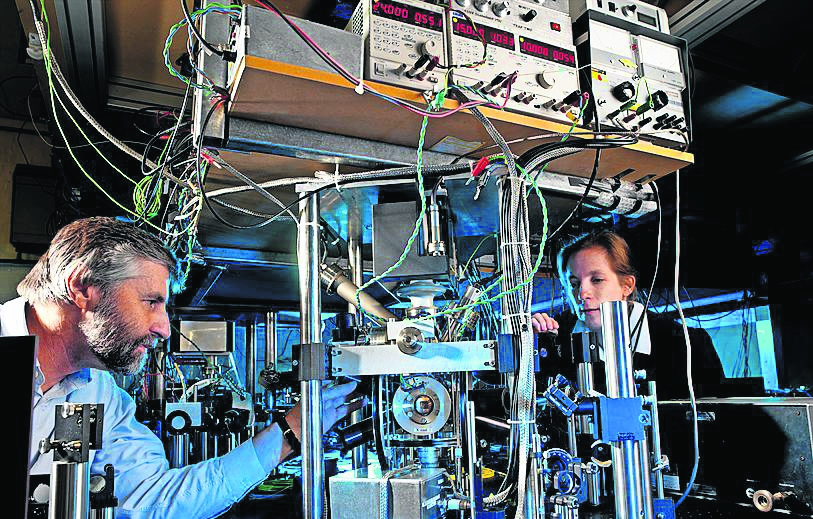
Patrick Gill and Helen Margolis at the National Physical Laboratory, Teddington

Next to Europe’s most accurate clock, there is a screw. The screw is, said Rachel Godun, a timing scientist, “the most exciting screw in the lab”.

Probably, metrologists differ in what they view as exciting in screws.

But, still, it is a special screw: the National Physical Laboratory (NPL) in Teddington had to get in surveyors to deduce its precise altitude.

We need that screw because there is no point in being Europe’s most accurate clock if you can’t adjust for the relativistic effect of gravity. As Einstein found out, clocks at different heights run at different rates. So you need to know how high you are.

That’s just the start of the adjustments needed. As NPL works with other laboratories around the world to redefine the second, it even needs to take account of the moon. Every day, tidal forces in the Earth’s crust mean that the screw goes up and down by 50cm. “You have to worry about everything,” said Helen Margolis, head of science for time at NPL.

Such are the considerations required, when your clock is so accurate it would have lost barely a second in the lifetime of the universe.

What, though, is a second? You might think you know. A second is a 60th of a minute, a minute is a 60th of an hour, an hour is a 24th of a day, and a day is how long the Earth takes to rotate.

You would be wrong. That definition hasn’t been right for 60 years. The rotation of the Earth, as a marker of time, is ludicrously inaccurate. It wobbles, it shifts, it changes. Today, a second is instead, 9,192,631,770 oscillations of a microwave beam when tuned to a caesium atom. Much more rational.

If that doesn’t make sense, here is an explanation. To work, clocks need an oscillator. In a grandfather clock, the oscillator is a pendulum. In a traditional atomic clock, it’s a microwave beam.

While a pendulum keeps ticking at the same rate because of gravity, though, the microwave beam is kept regular thanks to quantum mechanics — and a caesium atom. If you hit an atom of caesium just right with a microwave beam, then an electron in the atom moves to a more energetic state.

What the clock does is use that to make sure its microwave beam is always oscillating at a constant, known, frequency. So long as the electron in the atom is moving, the beam is doing what it should. Then by counting the beam oscillations, you know what a second is.

But in this laboratory, and others around the world, they are working on a new, better, definition that they hope to have in place by 2030.

While caesium needs a microwave beam to excite it, the element ytterbium requires a laser beam — and it oscillates a lot faster. Faster oscillations mean you can get more accurate seconds.

So, in a box in their laboratory they have a single ytterbium ion and a laser.

By using it instead of caesium, they reckon they can get a time standard that is 100 times better.

The question is, why? One answer comes in exactly its response to height.

If your clock is so accurate that it is affected by the gravitational effects of relativity, then you could use it to measure those effects.

Slight changes in gravity, or altitude, appear in the time signal — helping with ultraprecise navigation and surveying.

Another reason is because we can.

When, in this same laboratory, Louis Essen invented the first practical atomic clock, no one needed time to be that exact. Today, such clocks have allowed us to probe physics — more accurate ones still would allow us to go further.

Atomic clocks have also allowed us to get around better: satellite navigation simply could not work without them. At the very least more accurate clocks would mean more accurate navigation.

But to redefine the second, we have to agree on what it is. In the world’s top timing laboratories scientists are firing lasers at atoms like ytterbium, and counting how many oscillations a second — a second defined by caesium — keep them excited. Then, once they converge on the same optical frequency, and agree on the atoms to use, the caesium version can be ditched. When it is, when time itself — something humans have always understood by the passage of the sun — is defined instead by ytterbium, what will that mean? What, I ask, even is time? “What is the time? We can do that,” Margolis said. But time itself? “We’re practical, not philosophers. I’m with Einstein: time is what you measure on a clock.” And that’s exactly what she does.

Wednesday, September 17, 2025

PH25004 Ghost Particles V01 170925


A sphere deep beneath a hillside will be bombarded with neutrinos, which will be measured by a global team of scientists

They are sometimes called “ghost particles”, so mysterious are they. And anyone who does not know what subatomic neutrinos are or how they work can feel somewhat reassured: until now, the world’s finest minds have not been quite sure either.

But if Wang Yifang of the Chinese Academy of Sciences, 700 physicist collaborators from around the world and a huge sphere filled with liquid buried deep beneath a lush green hillside get their way, that will soon change.

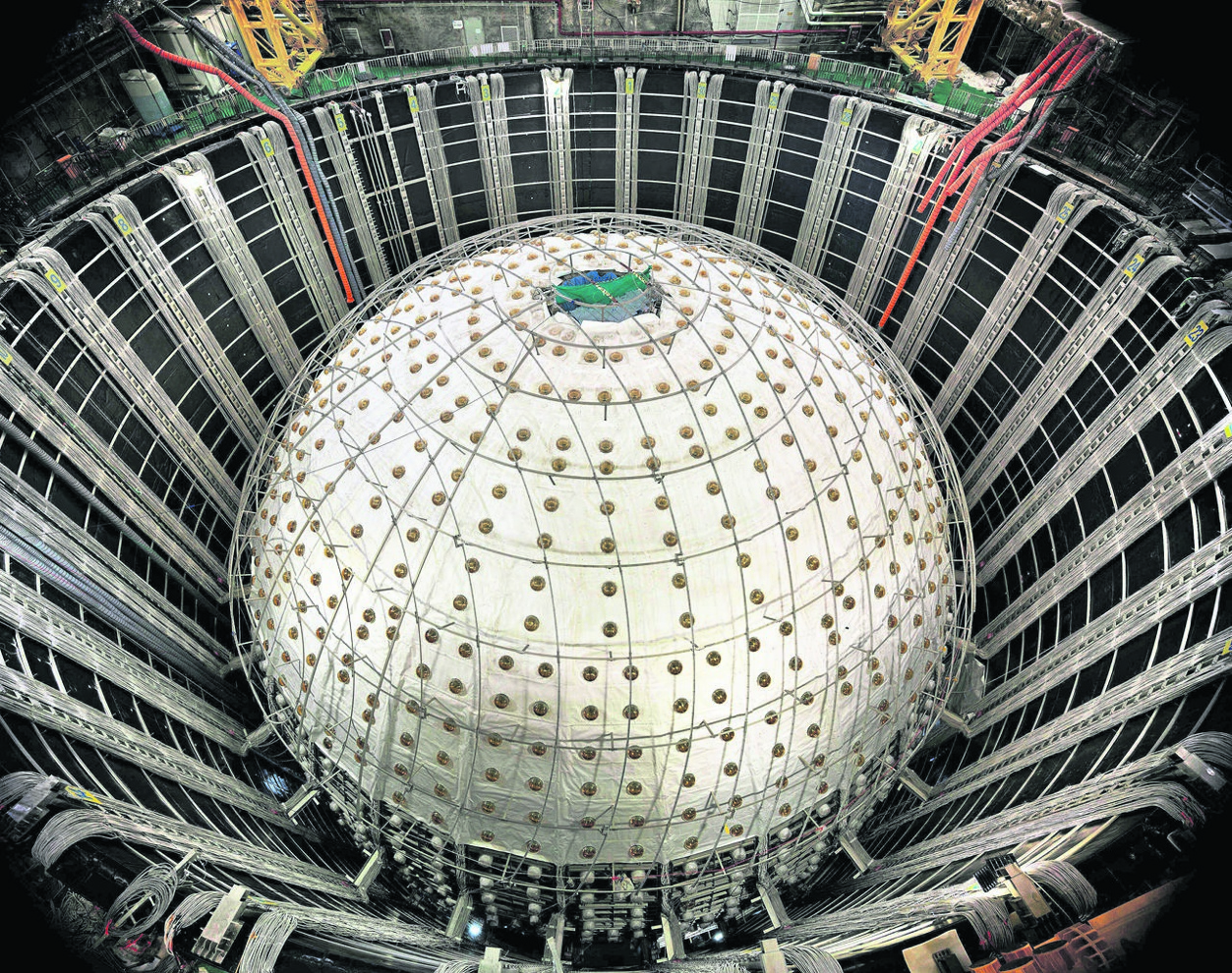
As of now, 20,000 tonnes of a substance known as a liquid scintillator, contained in the sphere, are being constantly bombarded by neutrinos flowing through the ground from two equidistant nuclear power stations. The sphere itself, a wafer-thin bubble of acrylic, is held within a protective cylinder containing 45,000 tonnes of water.

Bumping into protons in the scintillator, releasing tiny but recordable flashes at a rate of about 50 a day, the neutrinos are being remotely monitored, measured and ranked in mass by global teams of physicists. For neutrinos come in three “flavours”, the nature and hierarchy of which are vital to understanding the building blocks of the universe.

“We are going to know the hierarchy of the neutrino mass,” Wang told The Times, excitedly. “And by knowing this we can build up the model for particle physics, for neutrinos, for cosmology.”

The connection between subatomic particles and the big questions about the nature and history of the universe is well known, if hard to explain. “It’s very much related to our understanding of the universe,” Wang added.

“Soon”, he said, meant six years. That is the time it will take to generate the required 100,000 “flashes” that allow for statistically significant readings. It is satisfyingly precise, and Wang is confident that the experiment cannot fail.

Neutrinos are one of three types of subatomic “building blocks” of matter, the others being quarks, which come in six types, and charged leptons, which also come in three.

Like many discoveries of particle physics, the existence of neutrinos was postulated some years before experimentation proved their existence.

Indeed, Wolfgang Pauli, the Austrian physicist who predicted them in 1930, apologised for his finding, saying: “I have done a terrible thing. I have postulated a particle that cannot be detected.”

He bet a case of champagne that no one would ever detect one. Pauli lost that bet a quarter of a century later. But Wang’s liquid scintillator and the acrylic sphere, which lie at the heart of a facility opened last month in the southern Guangdong province, are an iteration of the same process, designed to prove conclusions that physicists have drawn but have yet to actually observe.

The Jiangmen Underground Neutrino Observatory, or Juno, will allow for controlled measurements of neutrinos that reach it from the two nuclear plants at Yangjiang and Taishan, on the coast. Each is 53km away, and Jiangmen, with its hill, is the perfect site.

Neutrinos flood through the universe from solar and cosmic rays, nuclear fission, and exploding supernova stars unstopped by physical matter.

They pass freely through Earth and indeed the humans living on it — hence the term “ghost particles”.

Pauli thought they had no mass at all, but the discovery that they come in three forms — called electron, muon and tau — has changed that theory.

Analysing how these forms interact — and in particular, how they oscillate from one form to another — should give clues to many of the subatomic world’s greatest secrets, such as the relationship of “matter” to “anti-matter”, and the problem of why there is more matter than its balancing opposite.

That connection to the concept of antimatter, and the cosmological significance of subatomic particles to understanding of black holes and supernovas, or exploding stars, has given a sensationalist edge to research in the field.

When the Cern large hadron collider, the behemoth of particle physics research, opened in 2008 outside Geneva, its scientists had to continually reassure journalists that it wasn’t going to generate a massive black hole that would consume the Earth, or indeed the galaxy. It is probably a good thing that American conspiracy theorists have a lot of other work on their hands at the moment. Jiangmen’s futuristic James Bond-style lair, visited via a passage cut 1,000 metres into the hillside, would be too good to ignore.

But in fact co-operation is the name of the game, rather than the international competition that nowadays most marks China’s relations with the West. Jiangmen is a follow-up to another China-based neutrino project, at Daya Bay, further east in Guangdong, in which American scientists took part. The US is not involved with Jiangmen, but collaborators come from as far afield as Taiwan, Russia, Europe and, in Britain, Warwick University.

After completing its work measuring neutrino oscillations, the facility will be upgraded and put to other uses. Perhaps the most exciting is the possibility of using it to measure a supernova. The Milky Way has not seen a supernova since Chinese astronomers 300 years ago spotted what is thought to have been one, so it is time one appeared.

“In our Milky Way there should be one per 100 years,” Wang said. Given that 99 per cent of a supernova’s energy is transmitted as neutrinos, Juno will have a lot to play with.

PH25006 Gravitational Waves - Obituary Rainer Weiss V01 220925

  Rainer  originally went to MIT to study electrical engineering but moved to physics Early in the American morning on September 14, 2015, r...