They are sometimes called “ghost particles”, so mysterious are they. And anyone who does not know what subatomic neutrinos are or how they work can feel somewhat reassured: until now, the world’s finest minds have not been quite sure either.
But if Wang Yifang of the Chinese Academy of Sciences, 700 physicist collaborators from around the world and a huge sphere filled with liquid buried deep beneath a lush green hillside get their way, that will soon change.
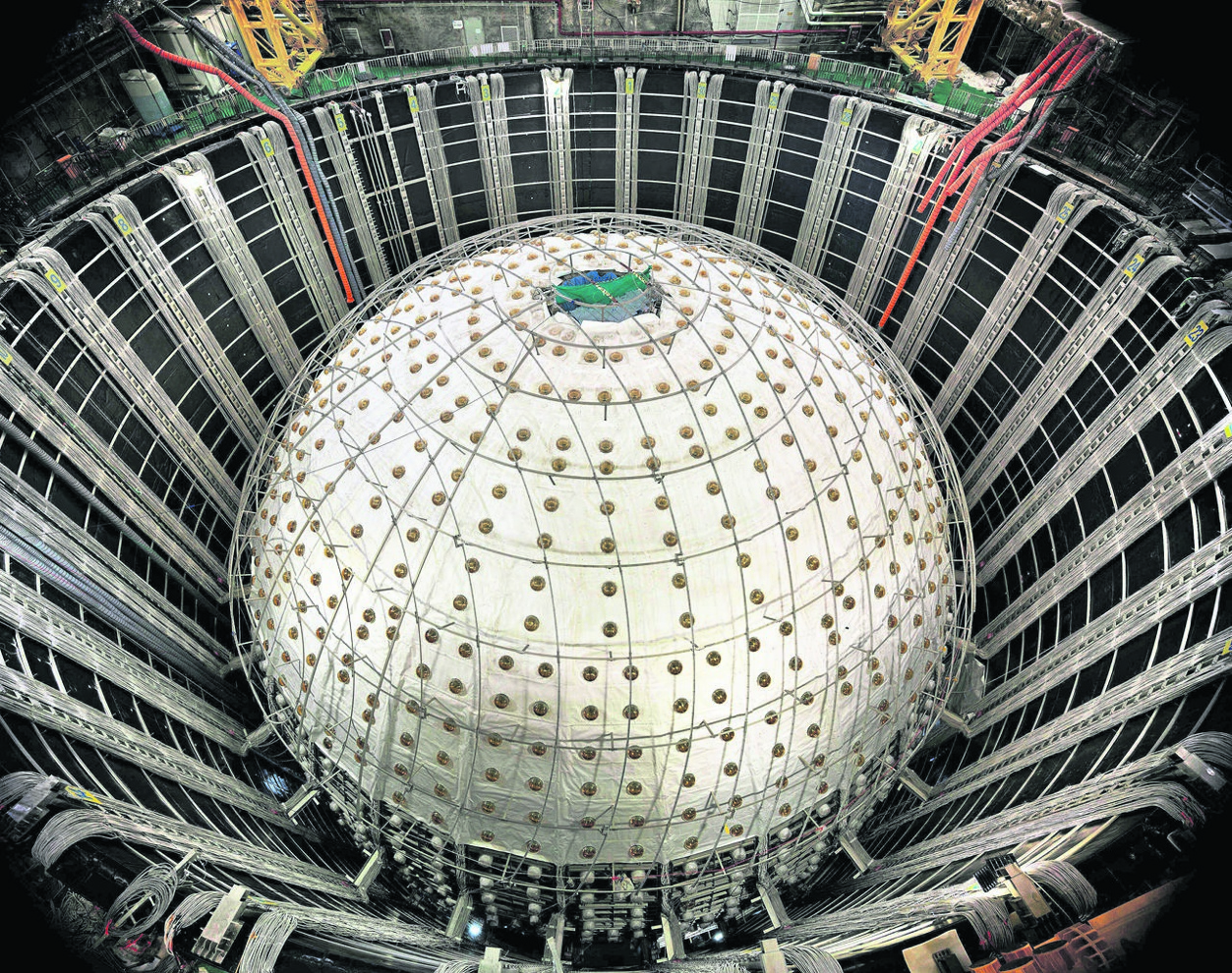
As of now, 20,000 tonnes of a substance known as a liquid scintillator, contained in the sphere, are being constantly bombarded by neutrinos flowing through the ground from two equidistant nuclear power stations. The sphere itself, a wafer-thin bubble of acrylic, is held within a protective cylinder containing 45,000 tonnes of water.
Bumping into protons in the scintillator, releasing tiny but recordable flashes at a rate of about 50 a day, the neutrinos are being remotely monitored, measured and ranked in mass by global teams of physicists. For neutrinos come in three “flavours”, the nature and hierarchy of which are vital to understanding the building blocks of the universe.
“We are going to know the hierarchy of the neutrino mass,” Wang told The Times, excitedly. “And by knowing this we can build up the model for particle physics, for neutrinos, for cosmology.”
The connection between subatomic particles and the big questions about the nature and history of the universe is well known, if hard to explain. “It’s very much related to our understanding of the universe,” Wang added.
“Soon”, he said, meant six years. That is the time it will take to generate the required 100,000 “flashes” that allow for statistically significant readings. It is satisfyingly precise, and Wang is confident that the experiment cannot fail.
Neutrinos are one of three types of subatomic “building blocks” of matter, the others being quarks, which come in six types, and charged leptons, which also come in three.
Like many discoveries of particle physics, the existence of neutrinos was postulated some years before experimentation proved their existence.
Indeed, Wolfgang Pauli, the Austrian physicist who predicted them in 1930, apologised for his finding, saying: “I have done a terrible thing. I have postulated a particle that cannot be detected.”
He bet a case of champagne that no one would ever detect one. Pauli lost that bet a quarter of a century later. But Wang’s liquid scintillator and the acrylic sphere, which lie at the heart of a facility opened last month in the southern Guangdong province, are an iteration of the same process, designed to prove conclusions that physicists have drawn but have yet to actually observe.
The Jiangmen Underground Neutrino Observatory, or Juno, will allow for controlled measurements of neutrinos that reach it from the two nuclear plants at Yangjiang and Taishan, on the coast. Each is 53km away, and Jiangmen, with its hill, is the perfect site.
Neutrinos flood through the universe from solar and cosmic rays, nuclear fission, and exploding supernova stars unstopped by physical matter.
They pass freely through Earth and indeed the humans living on it — hence the term “ghost particles”.
Pauli thought they had no mass at all, but the discovery that they come in three forms — called electron, muon and tau — has changed that theory.
Analysing how these forms interact — and in particular, how they oscillate from one form to another — should give clues to many of the subatomic world’s greatest secrets, such as the relationship of “matter” to “anti-matter”, and the problem of why there is more matter than its balancing opposite.
That connection to the concept of antimatter, and the cosmological significance of subatomic particles to understanding of black holes and supernovas, or exploding stars, has given a sensationalist edge to research in the field.
When the Cern large hadron collider, the behemoth of particle physics research, opened in 2008 outside Geneva, its scientists had to continually reassure journalists that it wasn’t going to generate a massive black hole that would consume the Earth, or indeed the galaxy. It is probably a good thing that American conspiracy theorists have a lot of other work on their hands at the moment. Jiangmen’s futuristic James Bond-style lair, visited via a passage cut 1,000 metres into the hillside, would be too good to ignore.
But in fact co-operation is the name of the game, rather than the international competition that nowadays most marks China’s relations with the West. Jiangmen is a follow-up to another China-based neutrino project, at Daya Bay, further east in Guangdong, in which American scientists took part. The US is not involved with Jiangmen, but collaborators come from as far afield as Taiwan, Russia, Europe and, in Britain, Warwick University.
After completing its work measuring neutrino oscillations, the facility will be upgraded and put to other uses. Perhaps the most exciting is the possibility of using it to measure a supernova. The Milky Way has not seen a supernova since Chinese astronomers 300 years ago spotted what is thought to have been one, so it is time one appeared.
“In our Milky Way there should be one per 100 years,” Wang said. Given that 99 per cent of a supernova’s energy is transmitted as neutrinos, Juno will have a lot to play with.



No comments:
Post a Comment