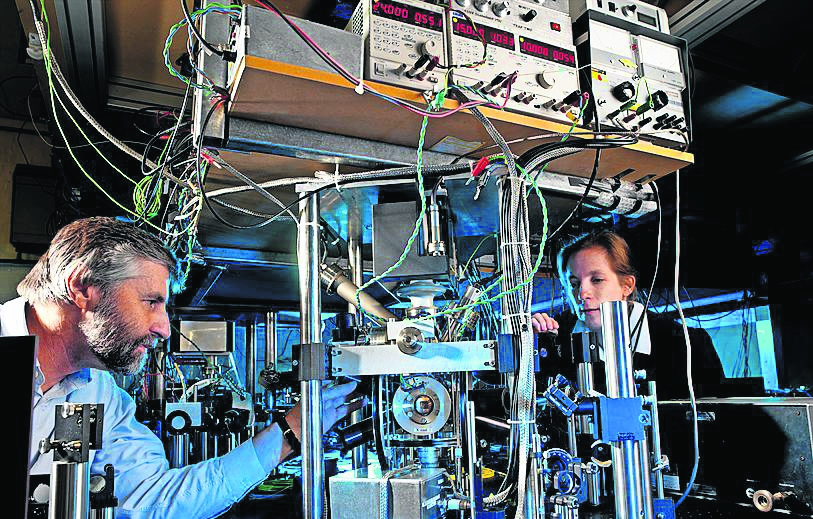
Next to Europe’s most accurate clock, there is a screw. The screw is, said Rachel Godun, a timing scientist, “the most exciting screw in the lab”.
Probably, metrologists differ in what they view as exciting in screws.
But, still, it is a special screw: the National Physical Laboratory (NPL) in Teddington had to get in surveyors to deduce its precise altitude.
We need that screw because there is no point in being Europe’s most accurate clock if you can’t adjust for the relativistic effect of gravity. As Einstein found out, clocks at different heights run at different rates. So you need to know how high you are.
That’s just the start of the adjustments needed. As NPL works with other laboratories around the world to redefine the second, it even needs to take account of the moon. Every day, tidal forces in the Earth’s crust mean that the screw goes up and down by 50cm. “You have to worry about everything,” said Helen Margolis, head of science for time at NPL.
Such are the considerations required, when your clock is so accurate it would have lost barely a second in the lifetime of the universe.
What, though, is a second? You might think you know. A second is a 60th of a minute, a minute is a 60th of an hour, an hour is a 24th of a day, and a day is how long the Earth takes to rotate.
You would be wrong. That definition hasn’t been right for 60 years. The rotation of the Earth, as a marker of time, is ludicrously inaccurate. It wobbles, it shifts, it changes. Today, a second is instead, 9,192,631,770 oscillations of a microwave beam when tuned to a caesium atom. Much more rational.
If that doesn’t make sense, here is an explanation. To work, clocks need an oscillator. In a grandfather clock, the oscillator is a pendulum. In a traditional atomic clock, it’s a microwave beam.
While a pendulum keeps ticking at the same rate because of gravity, though, the microwave beam is kept regular thanks to quantum mechanics — and a caesium atom. If you hit an atom of caesium just right with a microwave beam, then an electron in the atom moves to a more energetic state.
What the clock does is use that to make sure its microwave beam is always oscillating at a constant, known, frequency. So long as the electron in the atom is moving, the beam is doing what it should. Then by counting the beam oscillations, you know what a second is.
But in this laboratory, and others around the world, they are working on a new, better, definition that they hope to have in place by 2030.
While caesium needs a microwave beam to excite it, the element ytterbium requires a laser beam — and it oscillates a lot faster. Faster oscillations mean you can get more accurate seconds.
So, in a box in their laboratory they have a single ytterbium ion and a laser.
By using it instead of caesium, they reckon they can get a time standard that is 100 times better.
The question is, why? One answer comes in exactly its response to height.
If your clock is so accurate that it is affected by the gravitational effects of relativity, then you could use it to measure those effects.
Slight changes in gravity, or altitude, appear in the time signal — helping with ultraprecise navigation and surveying.
Another reason is because we can.
When, in this same laboratory, Louis Essen invented the first practical atomic clock, no one needed time to be that exact. Today, such clocks have allowed us to probe physics — more accurate ones still would allow us to go further.
Atomic clocks have also allowed us to get around better: satellite navigation simply could not work without them. At the very least more accurate clocks would mean more accurate navigation.
But to redefine the second, we have to agree on what it is. In the world’s top timing laboratories scientists are firing lasers at atoms like ytterbium, and counting how many oscillations a second — a second defined by caesium — keep them excited. Then, once they converge on the same optical frequency, and agree on the atoms to use, the caesium version can be ditched. When it is, when time itself — something humans have always understood by the passage of the sun — is defined instead by ytterbium, what will that mean? What, I ask, even is time? “What is the time? We can do that,” Margolis said. But time itself? “We’re practical, not philosophers. I’m with Einstein: time is what you measure on a clock.” And that’s exactly what she does.



No comments:
Post a Comment